


Jennifer's article on the "Five Things Everyone Should Know How to Do" was featured as a guest editorial on rAVe's HomeAV Edition on August 13th. This email is distributed twice a month to professionals in consumer electronics, audio-visual equipment, and technology spaces. Find the article here.

I read with interest the restructuring announcements from Google this week, as they rebrand the parent company into Alphabet, building out the letters with innovative products and business models - starting with “G” for Google, which remains a wholly-owned subsidiary. It’s a bold move for a company that doesn’t want to be conventional.
This got me thinking about our own personal branding efforts and how we can apply Google's bold lessons to our own career paths.
1. Your past is only part of your story
Google is known for search and related properties, but the management team saw that strong association as a strength of Google (the products) and a limitation to Google (the company). Making that same distinction between what you do and who you are and want to be, is extremely useful. Early in your career were you known as the person who organized events, the person who could calm agitated customers, or the person who could help someone with their Excel questions? Although those things are useful and might still be part of your portfolio, they are not all that you are, nor do they limit you in the future. You can delegate (as Sergey and Larry did with Sundar taking over Google or Susan running YouTube), train and coach others, and step away from what you were great at in the past, to develop new capabilities. Reinvention isn’t just possible, it’s required, to move forward.
2. Leave room for more
Google is still a huge part of their portfolio, naturally, but with the rebranding effort, they made room for other companies, sub-brands, and initiatives to build out the portfolio. If G is for Google, they literally have left room for 25 other multi-billion dollar ideas. If you thought about what you do as just one letter in your alphabet, how could that shift your thinking? How could you play bigger thinking that your career to date has just been one chapter (or the prologue) of a larger story? No one else knows what you are capable of, maybe not even yourself, unless you apply yourself to this line of thinking.
3. Good times are a great time for change
You have heard the adage, “if it ain’t broke, don’t fix it.” I don’t think anyone would say Google’s business model was broken. Yet, they felt urgency and took action to change when things are going well. Some analysts have commented that most companies don’t announce a “restructuring” when things are going well, their stock is flying and their market cap is pointing heaven-wards. Usually, those words are reserved for companies that are struggling and require massive surgery and intervention to stay viable. It is difficult to contemplate a change, especially a big one, when things are going well, but that might be exactly when you need to make a change. Perhaps it is time to retire the “don’t fix what isn’t broken” advice, and rather strive to be a person who is willing to give up good ideas in favor of great ones!
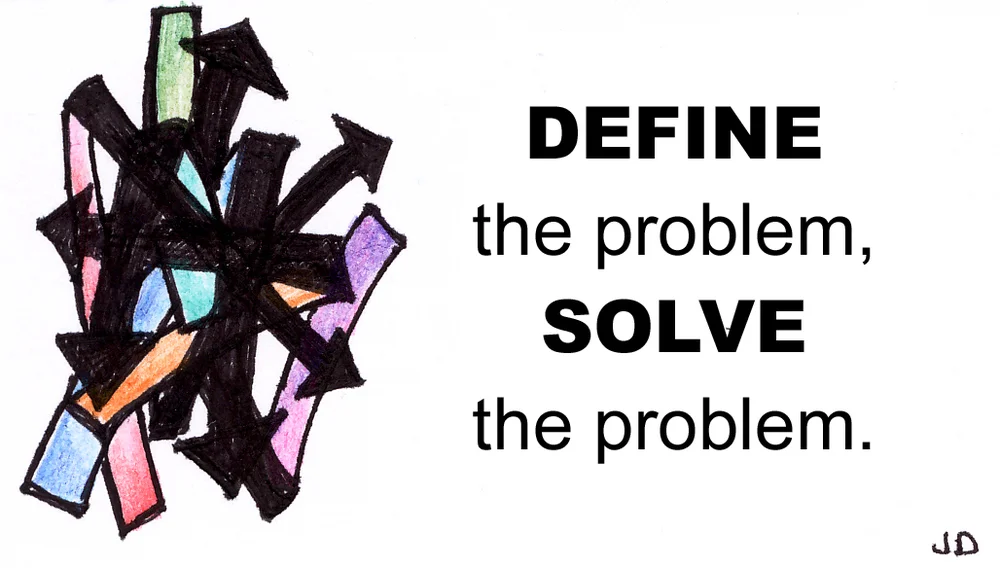

I personally find it very helpful to frame a problem in the form of a question (namely a "how" question), especially if you are seeking input from others. The more specifically you can articulate the problem, the better you will be at identifying solutions.


I suspect this applies to more than just monster roller coasters.



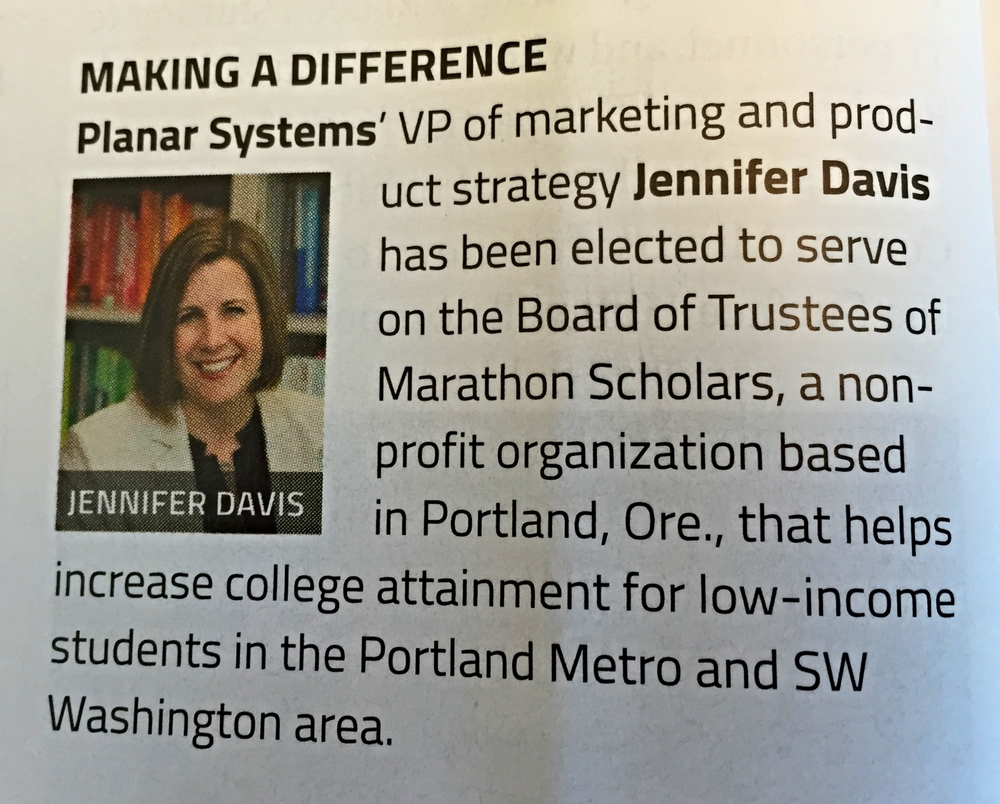
The July issue of Commercial Integrator magazine featured the announcement of Jennifer Davis to the board of Marathon Scholars.
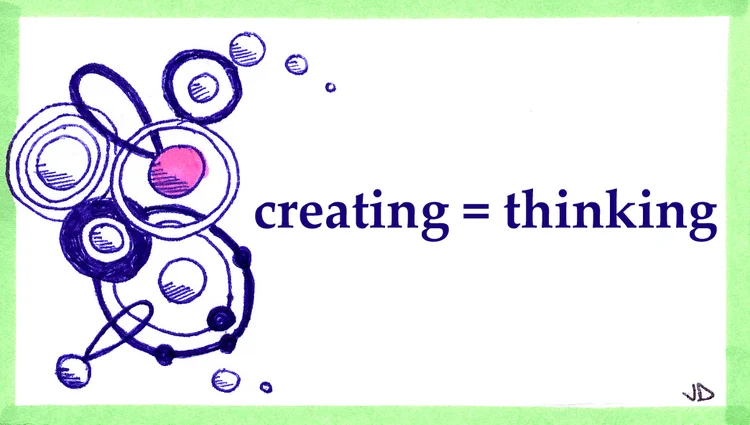

A lot has been written about the different style of learning and how people approach thinking in different ways. Sir Eric Robinson touched on this in his popular TED talk about how schools are killing creativity. In the talk, he refers to a famous dancer and choreographer who finally find other people who thought like her (through movement) when she joined a dance class in elementary school.
Others of us think by creating. Some of us build physical models or like to get hands-on. Others of us think by drawing. Or by writing.
This week, think about how you think and experiment with some different approaches to see what new ideas emerge.

I just returned from a Frost & Sullivan marketing conference in which I participated in discussions around the alignment of sales and marketing. The mere mention of the topic brought out emotions on both fronts and it was clear that done poorly, the relationships devolve into a Dilbert cartoon (or “sock puppet theater” as one presenter noted), with both parties suspecting the others of subterfuge and buffoonery. Marketers are often left wondering how they can better market “marketing” within their organizations and to their leadership teams.
Let’s face it, many companies de-value marketing. Some consider it the department that makes pretty pictures or that it is simply the administrative support for the sales team. Others strongly value the strategic involvement of marketing in product strategy, branding, strategic planning, and industry leadership. I am blessed to work for an organization that models the latter, but I certainly am familiar with the former.
Usually, this lack of respect or understanding for the role of marketing in the organization takes two forms:
- Exclusion from decision making and strategic conversations (a focus on tactical execution only, often exemplified by only having junior marketing staff who report up into another function like sales or G&A)
- Lack of adequate resources to do high-quality marketing work (budget, time, or resource limitations that keep the work tactical and reactionary)
This topic is a big one (worthy of more than one post). To get the conversation started among follow marketers, here are four key questions that you can ask yourself to help you answer the question of how to market “marketing” in your organization.
1. Can you express your motivation for wanting to market marketing in terms of overall business results?
Do you think that investing in a marketing automation system and nurturing campaigns will generate 20% more revenue next year? Do you believe that improving the brand consistency across the organization will lead to higher customer perception of quality and improve gross margins by 2% for the next product launch? Do you believe that developing a new interactive platform for sharing product benefits with your sales channel will reduce the sales cycle by 2 months resulting in a 13% increase in revenue with the same effort? Do you believe that having a seat at the decision making table would improve the company results or employee engagement demonstrably? Can you describe, in plain English or in understandable data, the financial benefits and returns of marketing investments? These are the types of questions you should be asking, when you are thinking of advocating for anything in a business environment. What is the business impact for the change you are advocating?
If you don't know how to answer these questions, it could be an indication that you are not yet ready to advocate for a larger and more impactful role for marketing in your company... and that you should get ready. That in itself, should be a call to action to learn more about your business, your drivers of value in the market, your customer problems, your solutions, revenue or customer attribution models, and overall business strategy...and how score is kept financially in your business. You must strive to be a business person, as well as a marketer. And today, those should be distinguishable.
And don’t be lured into advocating that there is no ROI on marketing investment. That is an archaic way of viewing the world and simply isn’t true. Sure, people have wasted money in “marketing activities” (I’ll get to that below). Sure, some data is just too expensive to get reliably in marketing (and I would argue, in every other function of a business), so business decisions must be made based on the limited information available. But you can describe the financial impact of nearly every decision of your business and marketing is no exception. If you find yourself defending "marketing" without data, go watch the movie Moneyballand see yourself reflected in the dialogue between the salty sports recruiters and Brad Pitt’s character. It’s a new era for business people doing marketing, with more transparency and accountability than ever before, and you must be leading the charge.
2. What is the perception of your brand and that of "marketing" in your organization? What should it be? What is the gap?
Before you would embark on a brand building campaign, you would always begin with data to identify the "as is" state and to quantify the "to be" state. And to identify the gap between these states. Often this accomplished with surveys, voice of the customer, share of voice analysis, or other tools. Why not do the same thing within your organization to gauge how far away the organization is from what you envision as the ideal?
It is also important to know whether your brand is strong enough in the organization to lead that charge? What are you known for, personally, in your organization? Why do people come to you? Does that align with what you need it to be to advocate the change you are advocating? What can you do to change the perception and reputation, if necessary? Are there projects that you need ot delegate to others (ie, the company holiday party, responsibility for the receptionist, etc) to improve the perception of marketing as strategic in your organization? Who else do you need to advocate on your behalf?
3. What "marketing" does your customer really need?
This should probably be the first question, as anything (besides that which is required for regulatory, legal, or financial compliance) that isn't seen and appreciated by customers, probably isn't worth doing. It is the definition of waste and the hallmark of bureaucracy. But coming back to my point, what value does the customer perceive in the marketing you do?
Are your customers able to make better and faster purchase decisions because of their access to technical information? Are your resellers able to sell more because of the sales tools you provide? Are they able to reduce their costs with more accurate quoting resources? Are they able to achieve business results because of the value proposition of the products you provide? Does your marketing help set your company and brand apart in measurable ways?
Some service firms have found that dedicated sales and marketing staff is not nearly as effective as sending their consultants right out to their clients to share expertise directly and we their appetite for more (a topic covered extensively in Patrick Lencioni's book Getting Naked). Some technical engineering firms, web site developers, or agencies find that their engineering teams are best equipped to sell and market to their technical buyers and that all that is needed from marketing is some communication tools to help facilitate these conversations, as learned from colleagues at a recent event held by the Technology Association of Oregon at which I presented on this topic. In our business at Planar, there is a lot of "marketing" that happens in customer conversations with account managers and technical sales professionals in the field. This is good and necessary for our technical, system-style products. Part of the marketing team’s role in this case is to equip their sales colleagues to have these conversations and to aim them at the right targets for best success. Each business will be different, but successful marketing begins with an understanding of the customer.
and finally...
4. What is the winning formula that is worth repeating?
Like any system, it is important to look and inputs and outputs. If you want to answer questions 1-3, a good place to start is your wins. Where are some situations that have gone well that you think are worthy of replication? Go back and analyze a big order, a design win, or project award and ask everyone involved how it came to be, the touchpoints with the organization, what sales tools or marketing resources were used, and what made the difference. There is no sense automating or "improving the efficiency" of things that are not effective. Said another way, finding faster ways to lose money is to find a better way to drive yourself out of business. But, if you focus on what is going right, you will find a platform from which you can advocate smart change and gain the respect of the organization and the resources to replicate what is working. And chances are, if you know it is a winning example that can be replicated, others in the organization will as well, and you will have a common foundation to build trust and understanding.
Special thanks to Lisa Cole, Allison Cerra, Leilani Brown, and Mark Wilson for helping to refine these lessons learned.
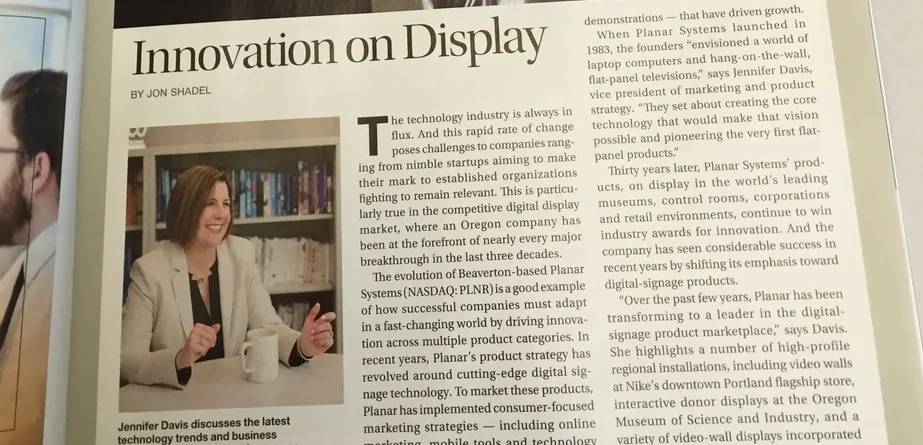

The hard copy of the magazine has arrived! To read the article about how innovation is on display at Planar, see the digital edition.


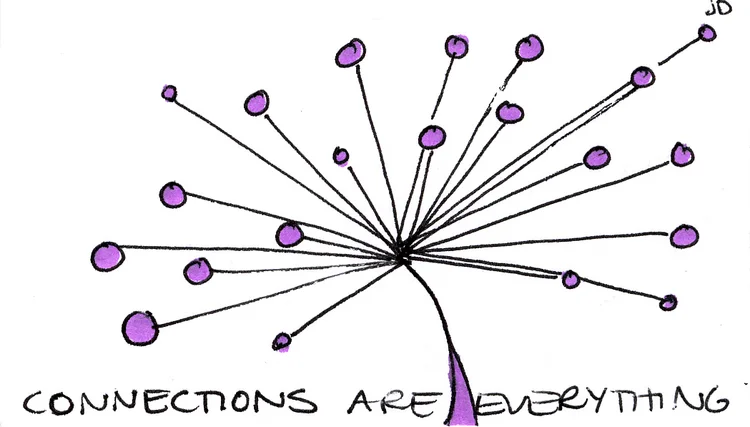

Call it the network effect. Call it crowd sourcing. Call it networking. Call it relationship building. Call it follow-through. Call it asking for referrals. Connections are everything.
It is connections that lead to new business, new insights, and new connections.
And the connections of your connections are even more powerful and far reaching.


Some children have imaginary friends. I had an imaginary town. It was called Butterfly Grove. Between 2nd and 4th grade, I worked on this multi-faceted project in which I envisioned the life and times of an entire town. Read more about it here.
In those formative years, Butterfly Grove taught me a lot and allowed me to experiment in ways that I have applied since then. The second is this:
Don’t Limit Yourself to How
As an amateur city planner, I had no idea how to build a city. I didn’t know the ends and outs of running these businesses. Designing the city was play and I was free to envision boldly.
This is reflected in some of the design choices I made. The high school was designed in the shape of a football (as I had envisioned a very strong sports program, apparently). The residential area of town was in a single “neighborhood” with streets named after wood varietals: maple, rosewood, and pine. I didn’t build a single major employer (or several) in the town, besides the various service businesses that I dreamed up. I guess I envisioned a community that just shuffled our money around, showing a lack of understanding of economics and the future eventuality of internet commerce.
As I grew up, however, I gained more skills. Like you, I became more capable. I now knew how to do things and have increasingly found my ideas constrained by the questions “How would we implement this idea?” or “How would we get started?” I can see the flaws and potential in things more quickly. I am quite accomplished now with coming up with an idea and then turning immediately around to make a list of all the steps required to execute. This has made me both an effective (and sometimes infuriating) leader. It has helped me communicate complex and bold visions to people by breaking down the steps necessary to get there. And it has caused me to unwittingly close off feedback or concerns early in the ideation process. It is never my intent to have my enthusiasm overwhelm a better idea or a word of caution, but I admit that it can at times.
These were not problems that my 8-year-old self encountered. I could dream unencumbered by the realities of execution. I could build, sketch, paste, and draw without worrying about the details. I could think about alternatives, seek inspiration from multiple sources, and most importantly, engage experts if I wanted to switch to the implementation phase (which I never really did).
The best and boldest ideas are ones that people might not have known how to do, but they knew clearly why they wanted to do them and what they would feel when the product or service was a reality. We see examples of this throughout the world of design and industry. I recently toured a factory where they employed a department of engineers to design the equipment used in the factory to move materials around (they were too big to do with conventional conveyor equipment so had to be invented). Large manufacturers, like those in the semiconductor industry, regularly have design all the production equipment in parallel to the processes that they will deploy the make the chips smaller and faster in the future. When they start designing the processes, they don’t know how they will do it, but they know it must be done.
A vision of where they are going is more important than having all the answers about “how” they will get there. It is precisely the “how” that the team is assembled to solve. But without the “why” and the “what could the future hold?” visioning, they have nothing to aim for.


Planar and it's innovative marketing is featured in the latest issue of Oregon Business magazine.


This is one of my favorite made up words: consolidarity. It is the combination of solidarity and consolidation. It is a group believing things should be combined. I like thinking about this as it relates to integrated marketing. Campaigns should be internally consistent and focused on a goal and they should bring groups together for that common good. Consolidarity.


Jennifer Davis will be present a hands-on session on media integration at the Xplorer Digital 101 Bootcamp in Seattle on August 6th, hosted by SEGD, the Society for Experiential Graphic Design. These session will highlight the technical necessities around developing and deploying experiences in 4k, interactivity, transparent display, and video wall installations. Click the link above to register or for more information.


The article "5 Things I Wish I Knew..." appeared in the Oregon Business Report this morning. Excited to see this article getting so much attention.
I had a chance to deliver a presentation based around this article at a meeting of the Women in Leadership at Planar this week. My colleagues gave me some fantastic feedback and shared with me what they liked and thought could be improved. I can't wait to present it again to integrate that feedback. It is wonderful to have a room full of mentors!


Some children have imaginary friends. I had an imaginary town. It was called Butterfly Grove. Between 2nd and 4th grade, I worked on this multi-faceted project in which I envisioned the life and times of an entire city.
Taking a fairly comprehensive design approach, I laid out the city (even built a clay model at one point), wrote the town newspaper (The Butterflyer) and envisioned the businesses that would be in the town. The pet shop was named after my sister, who loved animals. There was a local branch of the Bank of America. I designed a book store and coffee shop combo (decades before Starbucks had the idea) called the “Book and Bagel.” I even have a coupon book from the “Welcome Wagon,” I drew up to promote these businesses. It was a consuming project that I think back with fond memories to this day. It is just the kind of thing that I’d probably still enjoy doing.
In those formative years, Butterfly Grove taught me a lot and allowed me to experiment with innovation in ways that I have applied since then. The first is this:
Love Your Product
Butterfly Grove was a city that I would have wanted to live in. It had a small town feel, but modern amenities. I designed all the buildings and decided where they were located. I even got to pick the name of my street. It was the perfect town for my purposes.
In product development circles, there have been experts on both sides of this issue for decades: should product managers and entrepreneurs be data-driven, maintain passive attachment to their businesses, and keep an open mind with regards to customer feedback to see where to take their products or should they design things for themselves to use? Those in favor of the dispassionate approach, note the success of professional managers building conglomerate businesses without direct involvement in the business propositions of any one product line. Biz Stone, a co-founder of Twitter and author of Things a Little Bird Told Me: Confessions of a Creative Mind, falls squarely on the “you have to love and use your product” side of this argument. So does, Jason Fried, the founder of 37Signals and author of Getting Real, Remote, and Rework.
I had an experience with Jason 10 years ago that illustrated this well. I had contacted the support group at 37Signals whose produce Basecamp I have used to manage a variety of projects over the years. I had been highly recommending this tool and I knew they are always developing new offerings. I suggested to them that they develop a new interactive, collaborative scheduling service. The idea would be that it would allow a person to set up a calendar of events and allow people to RSVP. However, it would be more than an Evite (which is another tool I love and use all the time). The innovation that I was suggesting was that the tool would allow multiple events to be managed from one interface and that it would include an element of capacity planning. Let's say, a hair studio wanted to use a tool like this to accept online appointments. They could enter the number of stylists available throughout the day and the software would prevent people from overbooking, perhaps suggesting alternates that might work or managing a waiting list. I thought this would be cool for a variety of their small business customers and I knew that I could use it right away for a project I was working on for a non-profit “mothers of preschoolers” group.
But, I digress. I sent the idea to them in some detail. I received a response back that surprised me. I thought that I would get a "thank you and we appreciate your submission" generic email and that would be that. Instead, I got a personal email back from Jason at 37Signals that read "We will not be building the software you suggested. We only build things we can use and we wouldn't use this."
Needless to say, I was a little taken back. Jason is known for his strong opinions and, perhaps, email missives of this type are common in their organization. But, the whole thing got me thinking.
Here is a company that is very well-respected and builds great tools. They got a suggestion for what would be a great product (in my humble opinion) and they said, "no." No, because it wasn't something they were passionate about. No, because they wouldn't personally use it. If they had been running a pet grooming salon, a community center, or a doctor’s office, perhaps they would have seen the value. Since then, others have developed online scheduling tools for various purposes (from SignUpGenius to Doodle), but there still isn’t a great single tool that I know of for scheduling. So, my "collaborative scheduling" idea is out there for someone to develop!
Thinking back to those days spent on Butterfly Grove, I was certainly an amateur city planner in every sense of the word. The definition of “amateur” is someone who engages in an activity for pleasure, instead of financial benefit. The root of the word is the same French-Middle English word for "love." Someone who is motivated by the love of something. It has been said that if you do something you love, you will never have to work a day in your life. Butterfly Grove didn’t feel like work. I think this is a powerful lesson for innovation. Work like an amateur and build something you love.
Your lasting legacy won't be your accomplishments, but the accomplishments you enabled in others.
Some can visualize words. Some need to be shown pictures. And some need to experience things before they can learn. In any case, one style of communication doesn't work for everything. This affects not only formal education, but advertising and branding experiences as well.