
“Perhaps one has to be very old before one learns how to be amused rather than shocked.” – Pearl S. Buck


“Perhaps one has to be very old before one learns how to be amused rather than shocked.” – Pearl S. Buck
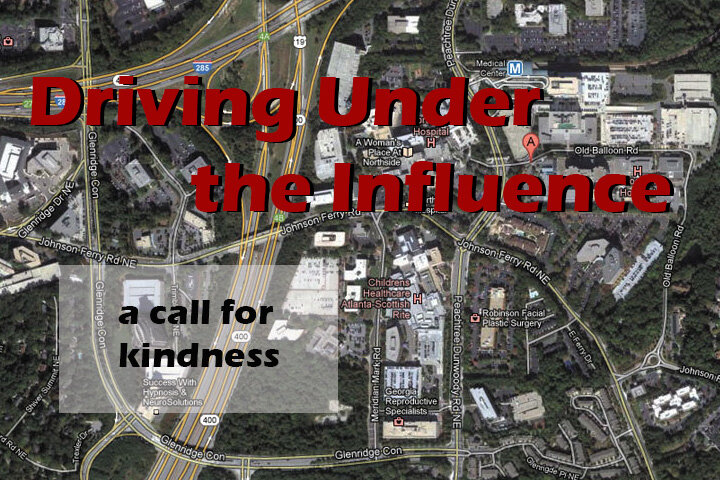
I used to commute past a hospital. To call it a “commute” is to be generous as it was two right turns between my home and the public transit station where I parked. And to call it a “hospital” isn’t quite right, as it was a multi-block complex with multiple hospitals, including a children’s research facility, clinics, hotels, and at least two emergency rooms. There were a few lights to navigate on this short stretch and I would often find myself observing or being impeded by folks going the wrong way, blocking the box of the intersection, going too fast, going too slow, and otherwise driving recklessly. Since the road was so familiar to me, I would often forget my own context. In my narrow view, I could believe that I was surrounded by cars breaking laws and risking the safety and sanity of other drivers. I could get impatient or confused. I was under the influence of my own thoughts, judgements, prejudices, and impatience.
While tuning out the world, I would be extra diligent to avoid getting in an accident myself. Not like those other drivers or pedestrians who weren’t paying such close attention. On other days, however, I would ACTUALLY pay attention.
I’d notice that the car speeding and cutting me off was turning into the driveway for the emergency room.
The minivan with the missing taillight who nearly caused an accident had much bigger things to worry about as they peered in the rear-view mirror at their cancer-fighting child in the backseat.
The driver who was blocking the intersection looked nervously at the passenger seated beside them, hoping that the test results were not what they feared.
The car crawling down the road at a snail’s pace with a new baby car seat in the back was driven by a terrified mom and dad wondering why the hospital let them leave so unprepared to care for this child (as I must admit I felt myself as a new parent).
Perhaps a family was debating treatment options or in despair realizing the gap between what they wanted to do and what they can afford to do while they missed the stop sign.
Maybe the person pulling out of the employee parking garage just got off a 12 hour shift and was physically and emotionally exhausted, relying on what remained of their last coffee to have the strength to push the accelerator at all.
I’d look at the pedestrian stumbling or shuffling across the street, not at the cross walk or at the light, and surmise that the distractions on their mind were more urgent than mine.
I decided that I didn’t know their stories, but if I was going to guess, I started to choose my judgements more generously. If you zoomed out, this small part of the city, measured by only few street lights and intersections, held the weight of thousands of extreme emotions. This is where families welcomed babies and said good-bye to grandparents. This is where children triumphed over disease and where disease sometimes won. It is where battles were being fought, twenty-four hours a day and 7 days a week. So, the small skirmishes on the road were nothing. If anything, these were a call to empathy, grace, patience, solidarity, and advocacy. I’d rather be driving under the influence of those virtues than their baser alternatives.
And that mindset change, changed the way I drove. I drove a little slower. I let people in. I overlooked the small stuff. I wanted to know the real stories. And I left many acts of kindness undone as it took me too long to see. I am still learning to see and choose my influence wisely.
Perhaps you have heard the quote or its derivatives* “Be kind, for everyone you meet is fighting a hard battle you know nothing about.” This is definitely true in what Atlanta calls “pill hill,” but it is true on your street, your city, and your country, as well. It’s true in your business and among your colleagues and customers. Whether we are behind the wheel or not, we are all driving under the influence of something. Choose kindness.
*This idea has been attributed to Ian Mclaren, Wendy Mass, Brad Meltzer, Philo, Plato, or Socrates.

“The great secret of success in life is for a man to be ready when his opportunity comes.” – Benjamin Disraeli

“Only fools and dead men don’t change their minds. Fools won’t. Dead men can’t.” – John Henry Patterson

“We ought not to judge of men’s merits by their qualifications, but by the use they make of them.” – Pierre Charron

“Great minds have purposes, others have wishes.” – Washington Irving

“People who can’t see without glasses should wear them.” – Malcolm Forbes

“Our grand business is not to see what lies dimly in the distance, but to do what lies clearly at hand.” – Thomas Carlyle

“They that will not be counselled, cannot be helped. If you do not hear reason, she will rap you on the knuckles.” – Benjamin Franklin

“In questions of science, the authority of a thousand is not worth that humble reasoning of a single individual.” – Galileo Galilei

“Some will never learn anything because they understand everything too soon.” – Thomas Blount
“Read every day something no one else is reading. Think every day something no one else is thinking. It is bad for the mind to be always a part of a unanimity.” – Christopher Morley

“They know enough who know how to learn.” – Henry Adams

“Humans are social animals. There are probably dozens of ways we absorb energy, inspiration, skills, and character traits from those around us. Sometimes we learn by example. Sometimes success appears more approachable and ordinary, because we see normal people achieve it, and perhaps that encourages us to pursue schemes with higher payoffs. Sometimes the people around us give information we need or encouragement, or contacts, or even useful criticism. We can’t always know the mechanism by which others change our future actions, but it is pretty clear it happens, and it’s important. Years ago, I mocked an intern for thinking his choice of neighbors would influence his career. If he’s reading this, I’d like to offer my apology. I can easily see that were you live might influence the energy you put into your career. If you live near optimistic winners, whose qualities are sure to rub off to some extent. And I advise you to consider is fact a primary tool for programming your moist-robot self. The programming interface is your location. To change yourself, part of the solution might involve spending more time with the people who represent the change you seek.”
– Scott Adams in his book How to Fail at Almost Everything and Still Win Big

“Unless the job means more than the pay, it will never pay more.” – H. Bertram Lewis

“Sleep not when others speak, sit not when others stand, speak not when you should hold your peace, walk not when others stop.” – George Washington

“To heal the breach between the rich and the poor, it is necessary to distinguish between justice and charity.” – Pope Pius X

“A sage thing is timely silence, and better than any speech.” - Plutarch

“How to be a great conversationalist
Ask questions.
Don’t complain (much).
Don’t talk about boring experiences (TV show, meal, dream, etc)
Don’t dominate the conversation. Let others talk.
Don’t get stuck on a topic. Keep moving.
Planning is useful, but it isn’t conversation.
Keep the sad stories short, especially medical stories.
The point of conversation is to make the other person feel good.”

“I never remember feeling tired by work, though idleness exhausts me completely.” – Sr Arthur Conan Doyle


