“The secret of change is to focus all of your energy, not on fighting the old, but on building the new.” – Socrates


“The secret of change is to focus all of your energy, not on fighting the old, but on building the new.” – Socrates

“Seeing too much is seeing nothing.” – Kai Wong, director of the China: Through the Looking Glass exhibit at the MET
Read more by Jennifer Davis about finding your focus.

Prior to the official start of InfoComm 2018, Avixa will host the first ever Integrated Life conference. On the afternoon of June 5th, Jennifer Davis, on behalf of her consulting business, BridgeSpan Media together with Canvas Research, will share some new and exclusive research conducted for this event.
In May 2018, a small sample of high net worth US households were surveyed highlights were shared at the conference. This summary research was conducted to inform a larger study that is being designed to delve deeper into trends, purchase motivations, and to provide a larger sample that would allow for regional insights (as homeowners in Dallas or Los Angeles face different issues than those in Chicago or Manhattan).
Use the Contact form on this website (or a direct message via Twitter) to express interest in the full research report once it becomes available. It will provide insights for the whole value chain from manufacturing brands to integrators and resellers providing local design, installation, and support.
Contact the research team at Avixa to share your interest in the residential market, as we partner with them on these efforts.
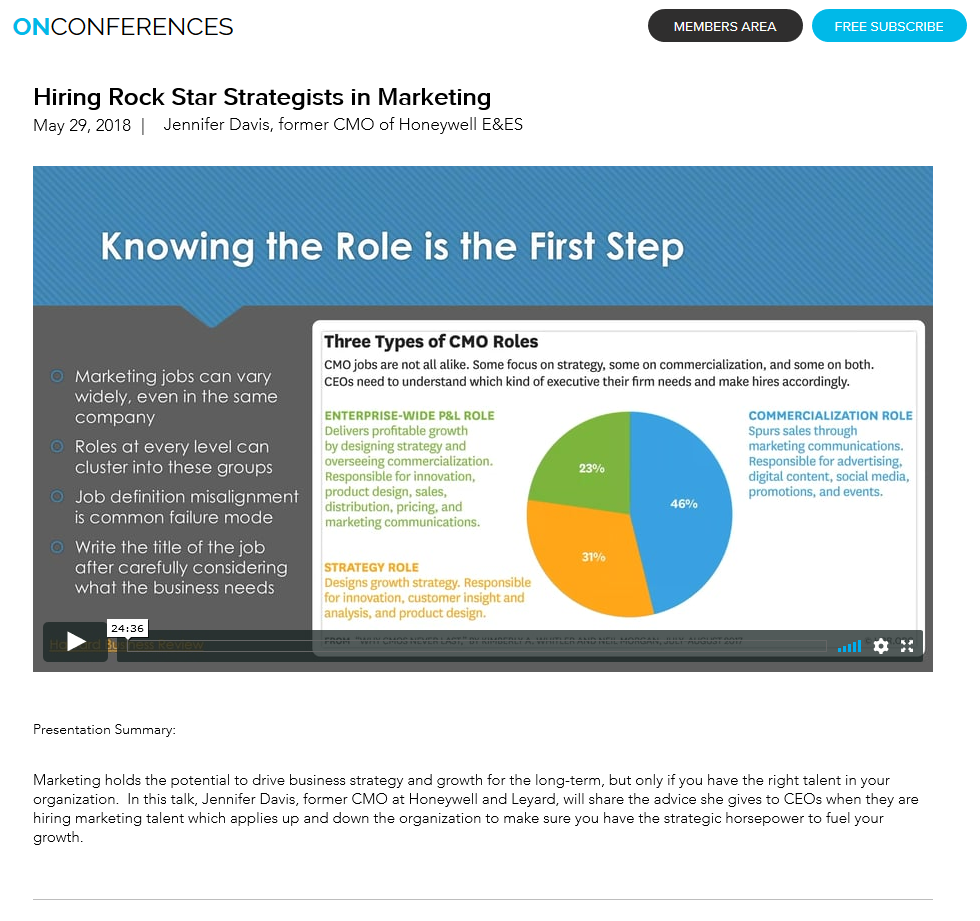
Marketing holds the potential to drive business strategy and growth for the long-term, but only if you have the right talent in your organization.
I had a chance to share some thoughts and techniques on how to hire marketers with great strategic thinking and business skills to build out your leadership teams. This keynote presentation is now available on OnConferences, a virtual conference featuring business leaders across multiple industries and functional disciplines.
In this talk, I share the advice I give to CEOs when they are hiring marketing talent. This same advice applies up and down the organization to make sure you have the strategic horsepower to fuel your growth.


“Love makes you brave.” – Rich Kannwischer

“Why do you go away? So that you can come back. So that you can see the place you came from with new eyes and extra colors. And the people there see you differently, too. Coming back to where you started is not the same as never leaving.” – Terry Pratchett
I recently spoke at the GeekOut on Marketing Technology hosted by the Technology Association of Georgia. As promised, here is the presentation with resources and references of case study examples noted. There is so much more to know about each of these case studies and the portfolio work of the talented firms I mentioned. Happy exploring! Download here.

“You don’t make mistakes. Mistakes make you.” – from The Last Word movie
Read more by Jennifer Davis about making mistakes.

Dogged pursuit of our goals is what sets winners apart from the also rans. Developing mental toughness isn’t just about being resilient. It’s not just about enduring. It’s also about training yourself to access your reserve tank when you think you just can’t go any further.
I attended a seminar hosted by 22squared which featured the author, entrepreneur, music lover, and ultra marathoner, Jesse Itzler. His high energy presentation talked about how you can develop your grit.
We all think we know our limits. Whether you’re pushing your body, mind, or spirit, there’s always that moment when you feel like tapping out. We think we know our limits, but in fact, we lie. To get past that point, Jesse explains a perspective-altering rule he learned from a Navy SEAL who came to live with for a month:
He would say that when your mind is telling you you’re done, you’re really only 40 percent done. And he had a motto: If it doesn’t suck, we don’t do it. And that was his way of every day forcing us to get uncomfortable to figure out what our baseline was and what our comfort level was and just turning it upside down. We all have that will. It’s just a matter of how we apply it not just to the once-a-year marathon, but to a variety of things in our daily lives.
Mental blocks take many forms:
These mental blocks - when your brain taps you on your shoulder reminding you of your discomfort and pointing you towards the exit - can occur anytime your goal isn’t bigger than your obstacles or your love of comfort (literally your comfort, or your comfort zone, figuratively).
To achieve our best we have to tamp down our inner sloth of laziness, the inner gremlin of criticism, and the ever-helpful voice in our heads that wants you to wrap us in bubble wrap to protect us from the bruises of effort. Instead, surprise them all with our resolve. Remind them that you aren’t fragile. Turn that resolve into actions. Actions of how we spend our time, our money, and our energy to accomplish really amazing things reserved for those who put in the effort.
The next time you feel like giving up, slacking off, or tapping out, instead retire your bubble wrap and realize you’ve still got 60 percent left.
You can find Jesse’s New York Times best-selling book, Living with a Seal: 31 days training with the toughest man on the planet, at your favorite reseller. Mine is on order.
This article was originally published on LinkedIn Pulse.

“What and How nearly never work without knowing first the Who and the Why” – Jennifer Davis

Join Jennifer on June 5 from 3:45 PM - 4:45 PM for a panel discussion on "Changing Consumer Habits and the Effect on Technology Experiences in Hospitality and Entertainment." This interactive panel will be part of the Integrated Life program at InfoComm, produced by Parks Associates.
Over the past few years, entertainment habits have shifted dramatically, ranging from streamed content to immersive interactivity. Today’s behaviors and preferences related to audio and video experiences are very different from habits of only a few years ago. New devices and greater interactivity affect perception of in-home AV needs for the newest generation of consumers and influences their expectations at hospitality, dining, or entertainment venues. This session examines the changing consumption habits of consumers and how those changes will affect all areas for AV products, services, and installation.

Proud to be among the speakers inspiring innovative and impactful use of digital to drive customer engagement and company growth at the Technology Association of Georgia's GeekOut on Marketing Technology later this month in Atlanta, Georgia.
Register and find out more at http://www.tagonline.org/events/geek-out-marketing-technology/
I'll be speaking on "Pixels in Places: Digital Marketing Hits High Street in Customer Experiences That are Worth Sharing," sharing how technology in physical environments can further other marketing initiatives when it is considered as part of the larger customer journey.
Other topics of the day include the following:
See you on the 24th!

Growth stops when you lose the tension between where you are and where you could be.”

“Once you get beyond tokenism, diversity changes the chemistry and effectiveness of a board.” – Joseph Evans, State Bank and Trust
For more on the importance of diversity, read "Fighting for Diversity: from the room where it happens."
Join me at the OnBoard breakfast on June 13th to honor the inductees into the hall of fame and to celebrate the progress that has been made to put more diversity on corporate boards in Georgia.

“Be the leader people would kill for, not want to kill.” – Trish Mueller
For more on leadership, check out "The Momentum of Business."

When an organization needs to add leadership, especially in times of growth and change, the process is fairly straightforward: the senior leader crafts a job and gets help from HR or an executive recruiter to find the best candudate. But what if it worked differently?
What if you helped recruit and hire your own boss?
It is not uncommon for staff to be involved in the interview process and some companies incent employees for referrals, but I am thinking beyond that. What if you thought about what you wanted in a manager and what you thought the business needed in a leader, and actively helped recruit that person into your organization?
Here is 7 reasons why reverse recruiting makes sense.
1. You can make sure there is a fit
Each person comes to the job with certain strengths and interests. You have yours and your colleagues have theirs. Who better to recommend the kind of leader that will compliment and cultivate these strengths than you? What are you looking to develop and in what areas do you want to be mentored? Hiring your boss is a great way to ensure that you are getting what you need from your career. It is a wonderful thing when the development path of individual employees and the business needs align, for a long time. And being involved in hiring your manager can start building this tenure and growth into your career at your current employer.
2. You can be more successful
If you select the manager that is the right mix of mentor and challenger, you will be successful which will translate into more opportunities for you, and your colleagues. And if there is a good fit and complimentary skills, you may find yourself being able to focus on the parts of your job that you excel at, making you even more successful longer term.
3. You will be happier
Extensive research, like this article in Forbes, has been done on why people leave companies and the analysis shows that people rarely leave companies, they leave managers. Employee engagement begins, and can end, here. Your direct manager has more impact on your job satisfaction than virtually any other factor in your work life, more than compensation, work environment, or specific responsibilities. Choosing wisely, can have an impact on your life, stress-levels, and overall career success.
4. You position yourself as a leader
Let’s say you are a senior marketing director for a company who needs a Chief Marketing Officer, a Controller, or a head of operations at your company. Do you want to wait until the CEO appoints a new leader or brings in a few final candidates for you to interview or should you be more proactive? To make a recommendation for a new hire is a risk, but no matter how they ultimately end up doing in the role, you having a conversation with leaders in your company to make suggestions on what they should hire and giving them some people to consider, helps position you as a leader and someone committed to the cause of growth. If you go proactively to the CEO to find out more about the role and how you can help recruit the best candidate, it shows that you are a committed, ambitious, and high-performing employee who connected in the community.
5. You learn more about your business and the objectives of your boss
When you ask senior leadership what they are looking for in a new hire and how their performance will be evaluated, you are getting a fresh perspective on what a successful candidate might look like and how you can help them be successful once they are onboard. Many functional leaders or individual contributors are surprised to hear how much of their boss’ performance measures are based on things like enterprise value (ie, stock price, market share) rather than on successful execution of activities. This perspective can make you a better leader in the business, as well, able to tie your own activities with the overall business goals.
6. You can influence the company
Those conversations about the role and success measures, can also put you in a position of influence. What is missing from the job description that you think is critical, but that the hiring manager might not be aware? What competencies would make this person successful leading your team? Want more diversity in your organization? Hire a woman or person of color. Ask what is changing in the function or market that might cause the company to want to adapt what they are looking for and recommend accordingly.
7. You broaden your network
When helping to recruit, don’t stop with the people you already know. It is always better to build your network before you need it and there is no better way to do so than to reach out to see if people are interested in working for your company. You have something to offer them. If they aren’t interested, they might know someone who is who they can introduce you to. Ask your college professors for recommendations, see who serve on non-profit boards that you respect, attend networking meetings or industry association events and ask around. Scour LinkedIn. Referrals will lead to referrals and pretty soon you have met a dozen people who might be your next boss, at your current employer if things go well, or elsewhere in the future. Or maybe some of them may go to work for you someday.
In his book, Under New Management, David Burkus describes how teams are built at IDEO, the legendary industrial design firm. The teams pick their leader, the leader doesn’t pick the teams. The talent gets to pick their place in the organization chart, under the manager and on the projects that make the most sense to them. Managers who find themselves without teams, can’t execute projects and are probably not in the organization long. I imagine those with too many employees, find themselves with more interesting work and bigger responsibilities and reward. What started as an experiment years ago, still permeates the culture. Perhaps it is time for your organization to do an experiment of its own.
This article was originally published on LinkedIn Pulse.

You own the problems that create problems for your customers. They might not be your fault, but they are your problem.
For more about your relationship with customers, read "Customer Feedback."

Several years ago, my young daughter was helping me organize my work office after a move down the hall. The stacks of business books that I had accumulated over the years (and referred to periodically and wanted to keep handy) promised us a very long evening. Then I considered explaining to her how to organize them, by theme or if we should painstakingly alphabetize them. It occurred to us that the easiest (and dare I say, the fastest) way would be to organize them by spine color in rainbow series. Red book covers lead to orange, then yellow, green, blue, purple, and then white and, finally, black. It took only a few minutes to organize the books this way and it had a few surprising and pleasant consequences.
It turned the practical into art: I can’t tell you how many people have walked into my office and commented on my books. “Did you organize your books by color?” they would ask as they smiled. This library of business books became an art installation which people wanted to talk about. It really does look great and brings a smile to my face, and to office guests, every time. Books became a conversation piece and helped my guests and colleagues get to know me better, not just because of the titles on the shelf, but how they were arranged. And I can tell you that I really like authors who write red books and orange books are trending.
It made things easier to find: Come to find out, I can rarely remember the exact title or the name of the author, but 9 times out of 10 I can picture a book’s cover. This narrows the search considerably and within a few seconds I have the volume in hand. I know others’ might not have this kind of visual memory, but I suspect many of us do. Forget the Dewey Decimal System, this is the hue-ey decimal system (I couldn’t resist). This is especially useful as I have recently relocated across the country to Atlanta, and found it was easy (and fun) to set up my home office for maximum productivity using this now familiar system.
It sparked my imagination: As art often does, my book arrangement sparked new ideas. I am working now on a system to organize my Outlook calendar to align appointments, meetings, and blocked time to my goals using color cues. For me, new business development work is green, one big project is yellow, family priorities are purple, and, naturally, any time spent building out my new network in Atlanta is red (the ubiquitous color of the Falcons, Hawks, Atlanta United, UGA, GSU, and classic Atlanta brands like Coca-Cola, Chick-Fil-A, and newcomer, Honeywell…need I go on?). Perhaps for the freelancer or consultant reading this article any paid “billable hour” work is blue and any office work is orange. You can do this manually or using conditional formatting, it can be done auto-magically as you create or accept calendar entries. You can use a more sophisticated time or task tracking tool (like a CRM) for even more insights. Turning my calendar into a visual dashboard of how I am spending my time is generating new insights and changing my behavior. The adage is true that you manage what you measure. Try it yourself and at a glance, you can see if you are investing your time – your most precious and limited commodity – fully to your goals and priorities.
Now you might be asking a different question: why do I hold on to these physical books in a world of instant Internet searches, ebook readers, and, frankly, when often the Harvard Business Review synopsis of the book is better than the long form? It is because I know it works for me. I like books. I dog-ear the pages and write in the margins. Sure, I sometimes snap quotes into Evernote for future blog posts, but in the meantime, I like them stacked on my night stand and standing in a colorful array in my office.
And, I hope that one day when I write my New York Times best seller, you will all still have bookshelves, maybe even sorted by color, and will appreciate the hue of the book jacket I chose.
_________
This article was originally published on The Buzz on April 6, 2017. Special thanks to Jeff Hilimire from Dragon Army for renewing inspiration to color code my calendar.

“Only a mediocre person is always at his best.” – W. Somerset Maugham, Playwright

According to extensive research into success and performance, each one of us approaches our work with a unique formula. When we are at our best, we tap into some natural talents, abilities, or experiences that we have honed. In his book, StrengthFinders, Tom Rath uses Gardner's research and outlines 34 themes or traits that show up in different combinations in these success recipes.
I recently took mine again and was amazed at the consistency from previous times I have taken the assessments under different circumstances, in different cities, and for different purposes. It seems that each of us have a "go to" recipe that becomes our signature dish.
Mine are Strategic, Maximizer, Positivity, Activator, and WOO (winning others over). This time Communication made it back onto the list as well.
So, what do these mean?
For me, they combine to create this recipe.
I see the big picture. I know how to make it better. I am positive it will work.
How soon can we start? Who's with me?
When I first articulated this, a long-time colleague joked that this was the pattern of most of the emails she received from me. I suspect she was right.
Those familiar with the assessments know that one of my themes is in the Strategic Thinking category, one is in Relationship Building, and three are in Influencing. Using my kitchen analogy, this represents my balance of salty and sweet. The Strategic and Maximizer seek out data, insight, and analysis until actionable patterns begin to emerge. Those patterns build confidence with Positivity and momentum with Activator. Activator also indicates my comfort with (and, frankly, need for) experimentation. We often can only start with a minimum viable offering or a test, but that then informs our strategy and our confidence for further investments. And throughout, with communication and influence, I am "Winning Others Over" (WOO). Creating the motivation to bring customers or colleagues in alignment with the new vision.
I can point to dozens and dozens of examples in my career where my recipe delivered great results. It is the common theme up and down my resume. Not everyone would have approached the problems or situations in the same way, and in fact, those perspectives are critical for strategic planning and action (and must be actively sought out, especially from those who are quiet in group settings or need more time for analysis). But underlying the successes is a creativity, energy, and conviction that prompts people to action and helps the business achieve more than it thought it could. It's my winning formula. It's my signature dish.
What is yours? I am curious to know what others have found in their StrengthsFinders assessments and how they are utilizing it to play more to their strengths every day.
Next week, I am attending a workshop where this and other assessments will combine to create a clearer picture of purpose and vision. For someone who likes to see the big picture and collaborate towards making things better, this is perfect. It just can't come soon enough.