Viewing entries in
#wayfinding

What Color Are Your Glasses?

Comment

What Color Are Your Glasses?

The other day I heard that in the ancient world the most important ideas were documented in poetry and today our important ideas are captured in spreadsheets.  Although not complete accurate, it is thought-provoking.  What important ideas, passions, or world views are wrapped in the allure of facts and figures and presented as data?  I have long contended that a spreadsheet was an exceptional tool for writing fiction.   Not that people mean harm or to mislead, but each time you have to complete a cell you are making a host of assumptions.  To use the vocabulary of Excel, every number in every cell is filtered.  Filtered by your point of view.

It is the time of year when people are wearing sun glasses.  Where I am from in Oregon, we might be even more sensitive after enduring (ahem, enjoying) months of overcast skies.  And each one of our chooses lenses to wear – both literally and figuratively – to view the world.  Some people wear rose-tinted glasses and see the world as friendly and optimistic (and boy, do we need more of those people in our modern world).  Others see it shaded gray.  Others buy specialty lenses that highlight colors or shapes, like the glasses one can buy for golfing that help the ball stand out on the green. 

An interesting thing happens when you wear glasses for a while: you no longer can see the tint.  Your eyes adjust and the world takes on the colors and meaning that you’d expect.  You know the sky is blue, even if your glasses tinge it green.

Our ability to characterize and categorize input (to know what data is important) and to adjust our perceptions to our world view (like our eyes adjusting to tinted lenses), is part of what makes us human.  And this humanity can make us blind to data that doesn’t fit into our table cleanly or points of view that differ from our own. 

I was working on a financial projection spreadsheet recently (that became even more convincing, I must say, because it was accompanied by a PowerPoint slide deck complete with infographic images and charts from a research analyst) and was reminded the power of the lens. 

When you are working on a presentation, you start by asking what you want the “take away” to be.  What do you want your audience or reader to understand better because of the presentation you are giving?  What decision do you want them to make?  And although it is proper presentation planning, that desired outcome begins its work of filtering and coloring the work of the presentation.  To avoid one-sided analysis, I sought alternative input and ended up putting in a few slides that presented an alternative view.  A different way to look at the issue at hand.  To open the door for discussion.  To guard against too narrow thinking.   And to document assumptions.

It was a hard thing to do: to get away from the data and the analysis far enough to see a different picture, to take in different input, to identify what had been “thrown away” to make the clean and compelling point.  But it proved to be valuable and, in the end, will lead to a better outcome. 

So whether your best ideas are captured in poetry or in spreadsheets, it is important to remember that your best ideas might be improved, if you take off your glasses.

This article was first posted on LinkedIn Pulse

Comment

Exhausted Genius

Comment

Exhausted Genius

“I’m exhausted. But the success is glorious.” – Albert Einstein, after presenting his decade-long quest on the theory of relativity, November 1915

Comment

Fear Less

Comment

Fear Less

English is a strange language.  Of that, there is no doubt or dispute.  The amalgamation and combination of various tongues and cultures have resulted in an ever-changing and nearly-impossible-to-codify language system that ranks among the most difficult to master.

I have been reminded of this recently when reflecting on the word: fearless.

There is a plaque in my office, created by a friend, that has this word written on the face.  She meant it as a compliment and a reminder.  She commented that she saw me as someone who fearlessly faced change, ambiguity, and challenge and created something remarkable as a result.  I am deeply humbled by this description.  I also know it was to serve as a reminder that I do my best when I bring my best, fearless self to the work at hand.  It has been my office for a while and having it there on the shelf, in the landscape of my periphery every day, is undoubtedly serving both her purposes.  I must admit, I leaves me with a bit of an imposter’s syndrome, because I know how many fears and doubts that I live with each day.  And I know I am not alone and that the word itself is part of the problem and possibly the solution.

But the word “fearless,” is often used to synonymously with fear-free.  “He ran fearlessly into the burning building to save the child,” the newspaper will report of the local hero.  “She has a fearless brush stroke,” they will sell of an artist’s boldness.  “He is fearless and just free-climbed Half Dome,” someone will remark about an athlete’s death-defying feats.  But any of these people will tell you that they have doubts.  They are not guaranteed success.  They have fears.  They are not fear-free, but rather they are overcoming their fears.  What does it truly mean to be fearless?

The answer might be hidden in the word itself.  The term “less” is a relative word.  It implies that it is less when compared to something else.  I am sure you can sting your eyes with “tearless” shampoo, but it is meant to imply a relative safety to other products on the market. We use words like seamless, matchless, baseless, careless, effortless, heartless, motionless, priceless, and thankless as if they are absolutes, but they are really descriptions of relation.  You can be seemingly tireless, but still get tired.  Tireless is what others observe, but the truth is far more nuanced.  The comparison you might make is between yourself and others or between yourself on different days and in different situations. 

In my experience, courage is not the anecdote of fear.  It is action.  Fear can be paralyzing, especially when combined with a vivid imagination, but the fearless face it down, give it a name, and move forward.  Not recklessly, but with calculated intention, identifying and mitigating risks.  To be fearless is just to strive to fear less than you did the day before and you do that with action.  Before long, you are accomplishing things never before possible.

We live in strange and scary times.  Unprecedented stress combined with new technologies bring the raw edges of humanity to the surface and the world stage.  If there was ever a time for fearlessness, the time is now.  

This article was published on LinkedIn Pulse

Comment

Don’t say "yes," just because saying "no" is scary.

Comment

Don’t say "yes," just because saying "no" is scary.

"Don’t say 'yes,' just because saying 'no' is scary."
- Isabelle Roughol talking about Volkswagon engineering cars to cheat emissions test instead of admit that they fell short of their public emissions goals

“Unable to reach the lofty PR goal, engineering chose to lie rather than disappoint the boss, which is how every other corporate disaster begins,” she continues.

Comment

Pursue Epic

Comment

Pursue Epic

“We can’t really afford to spend time on things, unless they have a shot of being really epic." - Phil Libin, former CEO of Evernote, now with General Catalyst

That is true for each of us.  Time is the only commodity that is of limited supply to everyone.  Use it wisely.  Pursue epic.

Comment

4 Ways to Think Like a Casting Director

Comment

4 Ways to Think Like a Casting Director

Disney, famously, calls their employees “cast members,” recognizing the role that they play in creating the experiences in their theme parks, in their movies, and in their stores.  The job of “casting director” has been long considered a key one in the movie and entertainment industry, where these experienced professionals have the tough job of finding people who fit the director’s artistic vision.  This could be finding someone with the right look, the right voice, the right celebrity, at the right price, with availability, to bring the vision to life.

Avoiding unethical or illegal discrimination of protected classes or physical characteristics, of course, all of us who hire would do well to think about our own vision for our team and consider some of the things that casting directors might when they fill their cast list.  Beyond the experience that might be on the resume or the work samples or portfolio that the candidate might represent, there are other aspects that can be key to the hiring decisions that borrow from the casting director’s playbook.  I call these the Four P’s of thinking like a casting director.

Personality: The energy that people bring to situations can help them succeed or fail in certain roles.  Sometimes described as “presence,” casting directors look for people who can successfully play the characters they are seeking to fill.  Does the person command respect?  Can the person play the quiet, supporting role?  The same is true of hires in industries outside entertainment. Too much energy and restlessness, can spell disaster for more detail-oriented roles.  An introvert might be exhausted by a position that requires constant interaction with team mates or customers.  Even the amount of team work required in a role might differ.  A cameo part might not require the actor to be that “coachable” or “easy to work with” when a role on an ensemble cast might require a lot of those characteristics.  Judging for this in an interview can be incredibly difficult, but is immensely more so if the hiring manager has not identified the ideal profile for the candidate.  “What are you looking for?” and “How can you test for that?” are great questions to ask.  There is a host of resources available on behavioral hiring, like Effective Interviewing! (which is an elearning, book, and classroom style training program in competency-based interviewing) which may be of use.

Purpose: The “job objective” has long fell off the professional resume, but it is good to understand the career objectives of the individual before hiring them.  The casting director might inquire as to why the actor famous for stand-up comedy is looking to read for a serious role.  Or why a Hollywood blockbuster actress, might choose to do an independent film.  Knowing the individual’s career goals and aspirations can allow their career path to align with the companies goals for many years.  When Anne Hathaway was cast in the movie Les Miserables, she was tapped not only for her acting skills, but also because of her personal passion for the cause of disenfranchised women, something that she spoke of regularly in her press interviews for the film.  The more candidates can relate and be excited by the purpose of the company, the mission of the firm, the content of the job, and the promise of the career path, the better for all parties.

Platform: Some actors are cast for roles because adding their name to the marquee or to the project, brings along a fan base and connections that would be unavailable for an unknown actor.  The same is true for hires outside entertainment.  Companies are often looking to bolster their reputation or brand by hiring a recognized expert well-known in the field.  Even new college grads might bring with them networks within their university, club affiliations, or community service connections with value to their new employer.  Experience sales people, certainly, are valued for the long-standing customer relationships that they can bring with them to their new employer.  Candidates looking for new roles in any discipline are well-served by thinking about their own reputation and network in their industry, their city, or the like and how that might benefit their company.    Hiring managers, or casting directors, are well-advised to think about the platform that their new hires represent and how to best leverage those for the good of the individual and the company.

Price: Of course, there is an economic element to hiring as well.  Can the budget of the film afford the actor with the biggest fan base?  Can the more senior, experienced candidate be afforded?  Can the organization afford the onboarding and training investment required in a more junior, early-career candidate?  There are trade-offs on both sides.  Casting directors are working within a budget.  So are hiring managers.  And that budget not only includes the expense of the employee, but the value of the work product to the organization. A casting director could come in under-budget and help produce a failing film by not having the right caliber of talent.  Likewise, any hiring manager can overpay for candidates as they try to find the right fit.  I recently saw a Leonardo DaVinci exhibit at the San Diego Air and Space Museum which recounted a letter he sent in 1482, at the age of 30, to Ludovico il Moro, Duke of Milan, where he indicated his knowledge of bridges and weaponry.  An early resume or cover letter, it has been called.  I think it does a great job of creating value for the kind of thing DaVinci brought to his future patron.  It is good for hiring managers and candidates to keep in mind the economic value of the role and to make sure they are finding the right fit on that front as well.

There are many other things that casting directors must consider when making their determinations.  It is a hard job that is fraught with controversy at times and I imagine the ones who are good at it make it look easy.  Those of us tasked with building high-performance teams, can learn from the examples of great ensembles who work together to deliver great performances and the professionals that work behind the scenes to ensure the right people are in the cast.

This article was posted on LinkedIn Pulse.

Comment

Millennials are Creators

Comment

Millennials are Creators

According to USA Today, the millennial generation (which is from 18-34 today) spends 10% of their day creating content.  What is the impact of this as they come into the workforce and into leadership?

Comment

What Would Ben Do?

Comment

What Would Ben Do?

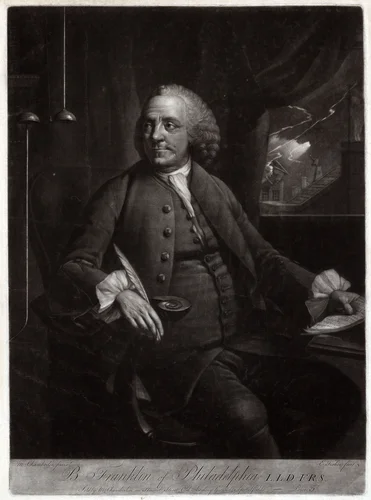
I wrote recently about Google’s efforts to provide the whole product in my article Y is for You: Google's Alphebet and Personal Branding.  I learned recently that one of the founding father’s pioneered some of these strategies himself: Ben Franklin

Ben wanted to be a printer.  His biographer (Isaacson) talks about the lengths to which he went to procure a printing press from Europe.  He wanted to own a communication machine.

He started printing things for his friends and customers.

So, to use the machine, he started a newspaper, the Pennsylvania Gazette.  If one flyer was good, then having a weekly or daily publication was even better.  Those who wouldn’t afford to print a flyer, could afford an advertisement in a larger publication.

He printed books.  The most popular book was the Bible.  But most people only bought one of those in their lifetime, so how could he get people to want to buy a book every year.  He started the Poor Richard’s Almanac which would have repeat customers every year.

Then he began to think bigger.  He wanted people to read his books and magazines, but many people were far sighted and had trouble reading.  So he invented bifocals.

He noticed that in the cold New England winters, people weren’t reading as much, so he invented the Franklin Stove.

He wanted to broaden his distribution channel to allow people outside of Philadelphia or the region to read his books and publications.  So, he championed the US Postal System.

And realizing that it was inefficient to print things in Philly and move them around the country, he franchised and shipped the plates to a friend in the Carolinas so she (yes, she) could build a business serving that community. 

A man with Ben’s broad curiosities and diverse background pursued these and many other ideas in service of his main themes and principles.  What are your main themes and principles that are worthy of the height of your creativity, enthusiasm and focus?

Comment

In the News

Comment

In the News

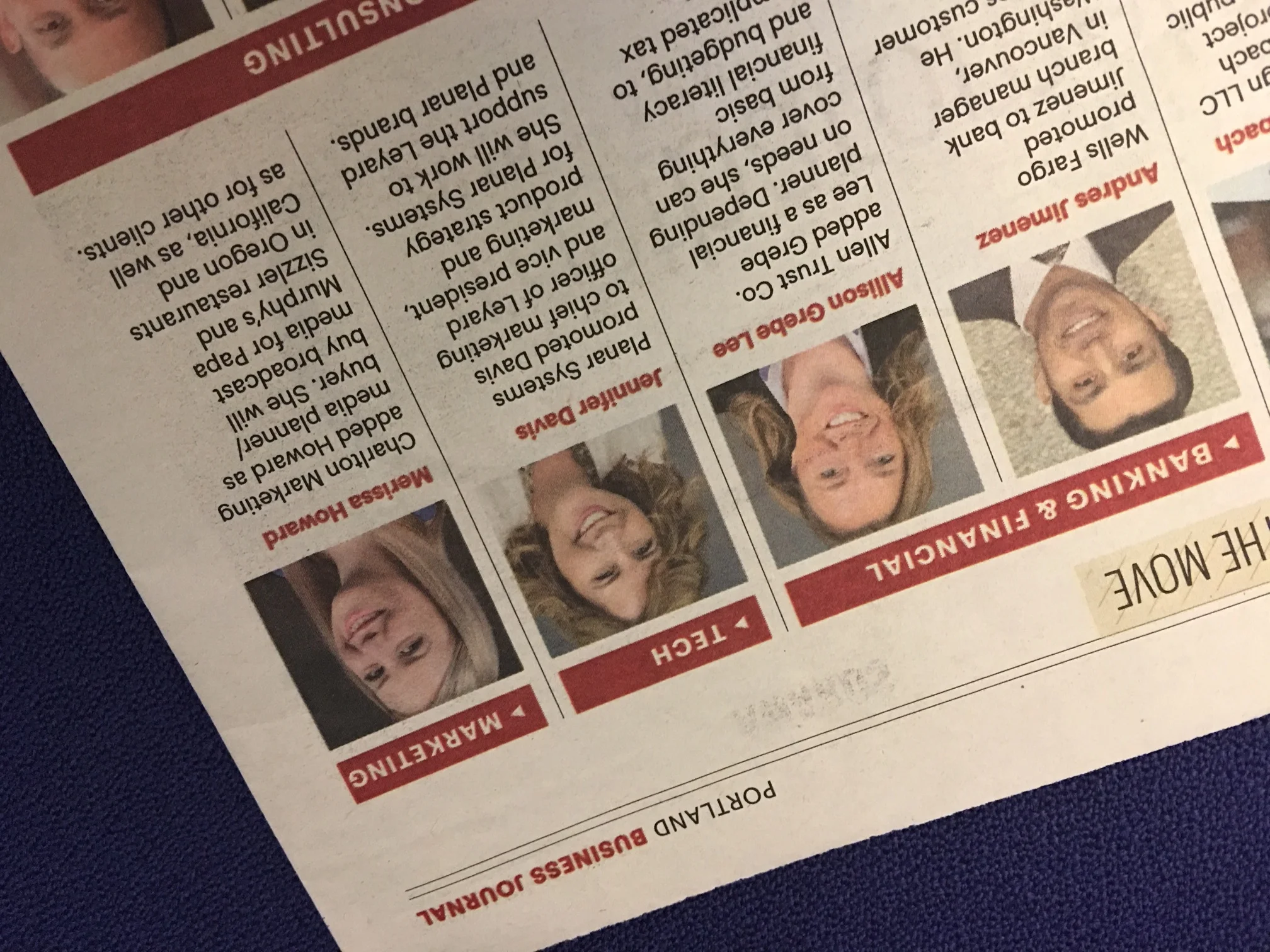
Jennifer was listed in the "People on the Move" section of the February 26, 2016 edition of Portland Business Journal. 

Comment

CTRL-ALT-DEL

Comment

CTRL-ALT-DEL

Every morning I unlock my computer with the keystrokes that I used to use to reboot it in case of terminal errors.  CTRL-ALT-DEL were the keystrokes of triage and now they are “hello.”  Maybe it’s a sad commentary on our world where “that was a disaster, let’s try again” is how we greet the day or maybe it is Microsoft’s way of reminding the computers that if they get sentient and go Terminator on humanity, we still remember how to do a hard reboot.  In fact, we’ve been practicing every day.

Comment

On-the-line-ophobia: the fear of responsibility

Comment

On-the-line-ophobia: the fear of responsibility

Seth Godin sited a survey in a presentation on which students were asked if they wanted to be a CEO of a global company, president of a non-profit, or the personal assistant to a famous singer or actor.  And over 40% of the respondents said “personal assistant.”  He described that the role of a personal assistant is close enough to the action to have bragging rights and to be part of the fun, but far enough away as to avoid the responsibility and vulnerability that comes with being in charge.

Are you afraid of responsibility?  Do you select roles where you are supporting others, implementing their ideas, or working their priorities?  Teamwork is critical and collaboration important, but do you work on teams to avoid personal accountability for the results of your actions?  Are you quick to blame others when things are not successful?  Are you comfortable and confident enough in your skills and opinions to advocate for them?

As Theodore Roosevelt said in his speech “Citizenship in a Republic” given in France in 1910, “It is not the critic who counts; not the man who points out how the strong man stumbles, or where the doer of deeds could have done them better. The credit belongs to the man who is actually in the arena, whose face is marred by dust and sweat and blood; who strives valiantly; who errs, who comes short again and again, because there is no effort without error and shortcoming; but who does actually strive to do the deeds; who knows great enthusiasms, the great devotions; who spends himself in a worthy cause; who at the best knows in the end the triumph of high achievement, and who at the worst, if he fails, at least fails while daring greatly, so that his place shall never be with those cold and timid souls who neither know victory nor defeat.”

See you in the arena!

Comment