Comment

Work as Offering

Promise:

My work is an offering to God who gives it meaning. 

Passage:

In the Old Testament times, God instituted a variety of offering or sacrifice types that brought Him honor and joy.  Some were large and significant, like a burnt offering during a high holy day done in the city of Jerusalem and others were not. A grain or other thanksgiving offering might have been smaller in scope or sacrifice, but all of them honored God and showed obedience.

Perhaps my work is the same.  When I have been in work transition, I have faced a decision with which you might currently be wrestling: do I apply for and take a lesser job (perhaps with a smaller title, less pay, and fewer responsibilities) or hold out for a larger job (which would bring more compensation, esteem, etc)?  Depending on what doors God opens and closes and my own patience, the former might be easier to achieve than the latter.  But perhaps one might leave me feeling like the talents and experience is being under-utilized.  It could leave me frustrated or wishing for more. 

When I reflect, I wonder if my angst is divine restlessness or ego?  Is it wanting to join God in a big work He is doing or wanting to orchestrate things for myself.

Jacob (grandson of Abraham and Sarah) was directed to return to a town called Bethel where God spared him from the pursuit of his brother Esau (in Genesis 35).  It is here that God changed his name to Isreal, promised that his descendants would include nations and kings, and asked him to set up a stone pillar as a monument and poured out a “drink offering” on it.  It is a type of offering that is mentioned in Exodus, Leviticus, and Numbers as a part of the Festival of Weeks.

Later in his letters to the church at Philippi and later in life to his protégé Timothy, Paul writes of his own ministry work being a drink offering.

Philippians 2:14-18

14 Do everything without grumbling or arguing, 15 so that you may become blameless and pure, “children of God without fault in a warped and crooked generation.”[c] Then you will shine among them like stars in the sky 16 as you hold firmly to the word of life. And then I will be able to boast on the day of Christ that I did not run or labor in vain. 17 But even if I am being poured out like a drink offering on the sacrifice and service coming from your faith, I am glad and rejoice with all of you. 18 So you too should be glad and rejoice with me.

1 Timothy 4: 6-8

6 For I am already being poured out like a drink offering, and the time for my departure is near. 7 I have fought the good fight, I have finished the race, I have kept the faith. 8 Now there is in store for me the crown of righteousness, which the Lord, the righteous Judge, will award to me on that day—and not only to me, but also to all who have longed for his appearing.

Although he had faced fires, he didn’t call his work a burnt offering.  Even thought he expresses gratitude in every letter, he didn’t call his work a thanksgiving offering.  Even thought he talks about sharing what he has with others in need, he didn’t talk about grain offering.  He described how he offered up himself is a pouring out.  It wasn’t a waste.  He had no idea at thee time of his writings to the churches and their leaders that thousands of years later we’d be reading his work and using those insights to get closer to Christ.

No sacrifice, if given joyfully and completely to God, goes to waste. So although I couldn’t possibly advise you about whether you should take a smaller or larger step in your career, a sideways or backwards step, or step out entirely into retirement or service work, what I can tell you is that work is important to God and anything offered in dedication honors Him.

Practice:

There is a traditional American folksong hymn entitled “Would you be poured out like wine?” that was published in the 1980s (attributed to composers Michael R. Greene or Tex Stevens, but not confirmed) that provides our reflection today.  Read these words and answer the questions below:

Would you be poured out like wine
Upon the alter for me?
Would you be broken like bread
To feed the hungry?
Would you be so one with Me
That you would do just as I will;
Would you be light and life and love My Word fulfilled?

Pause:

Reflecting on the song and the scriptures above, what does it mean to you to be a drink offering?  What might God be asking you to give up, pour out, or do in grateful response to His provision and love?

________________________________________________________________________________________________________________________________________________________________________________________________________________________________________________________________________________________________________________________________________________________________________________________________________________________________________________________________________________________________________________________________________________________________________________________________________________________________________________________________________________________________________________________________________________________________________________________________________________________________________________________________________
 

Comment

Comment

God Created Work

Promise:

God values work.

Passage:

The story of the Garden of Eden holds many clues for those wanting to know the heart of God.  When you zoom out on the specifics of the accounts, you find a few things that might shed light on your own life and work.  Let there be light! (see what I did there?)

First off, God worked.  Using words and vision, he created the universe.  In Genesis there are 2, possibly 3, distinct creation accounts woven together.  What scholars call the Priestly account is found in Genesis 1:2-2:4a and is a majestic, sweeping 6 day narrative where male and female humanity was created together.  The second, called Yahwistic account started in Genesis 2:4b and goes through 3:24.  It is a more intimate, earth-focused story where Adam (which is a genderless word meaning “ground”) is created from dust, then the animals, and then Adam is split down the side (translated “Adam’s rib” in some accounts) into two to create male and female.  A third, highly summarized account, is found in Genesis 1:1, which makes the point.  God is behind it all.  From the beginning, God worked and it was good. 

Then, God took humans and put them in a garden and asked them to “work it and take care of it” (Gensis 2:15).  We were asked to “subdue” the earth and rule over the animals (Gensis 1:28).  Naming the animals was also part of the human’s job in Genesis 2:19-20 (a task that echoes in modern branding, storytelling, and taxonomy work done by humans today).  Humans exerting authority over creation, stewarding resources, making decisions, and helping it all bear fruit is a direct reflection of God.  Work isn’t part of the curse of sin.  It doesn’t post-date the Garden of Eden.  It is a God-given gift and part of God’s original design.  Sure, the fall made the soil tougher and introduced weeds (they were technically not mentioned before the curse), but our work is part of the plan.  This is probably why people have a complete identity crisis when they retire or go through a job transition.  Work is good and from the Lord.

Colossians 3 talks about working as for the Lord, no matter the job.  There is no distinction between secular and spiritual work, as long as the activities themselves are not explicitly sin (like if your job is to steal or murder or eat from the tree of the knowledge of good or evil, then you probably should reconsider your career choices).  In the Bible, there are lots of types of work which are mentioned including preaching, raising children, skillfully playing music, holding political office, creating art, engineering, farming, fishing, and even leadership consulting (see the account in Exodus 17 of Moses’ father-in-law, Jethro, advising Moses to delegate).  The parable of the talents in Matthew 25 would imply that making a profit from investments is also work worthy of praise.  Again, work is a gift of God and using our talents helps make the world a better place, brings His Kingdom to bear, and glorifies God,

Practice:

Read Genesis 1-3 and reflect on all that it teaches us about work.

Pause:

What specific jobs does God or humans perform in the creation story?  Where there any jobs that were more or less important?  Any jobs that were more or less spiritual?  What might God accomplish through your work for His glory?

________________________________________________________________________________________________________________________________________________________________________________________________________________________________________________________________________________________________________________________________________________________________________________________________________________________________________________________________________________________________________________________________________________________________________________________________________________________________________________________________________________________________________________________________________________________________________________________________________________________________________________________________________


Comment

Comment

Your True Identity

Promise:

You are the child and heir of the king of the universe.

Passage:

We all have multiple roles and identities that we play in our families of origin, at home, at work, and in the community.  Often a job loss will be accompanied by a loss of identity.  Who are you if you aren’t the leader of such-and-such or the vice president of so-and-so company?  This can be especially true if you have started your own business or worked for a highly-prominent brand which carried its own cache.

But you have a bigger and more permanent identity.

When you believed and professed faith, God made you His child (Galatians 3:26, John 1:12, 1 John 5:1).  An heir of the kingdom of God (Galatians 4:7, Romans 8:17, 1 Peter 1:3-4, and Revelation 21:7). Lavishing us in love (1 John 3:1). And as children we can be led by the Spirit of God (Romans 8:14), living out of our identity as God’s chosen people, with compassion, kindness, humility, gentleness, and patience (Colossians 3:12).  We are God’s special possession, declaring His praises (1 Peter 2:9). You his daughter and his son and are not orphaned (2 Corinthians 6:18 and John 14:18).

Practice:

Art can be a powerful way to experience truths about God.  The Bible is full of poetry and descriptions of spectacles that illustrated God’s nature.  You need to look no further than the sunset painted against the sky tonight to see God’s own artistry.

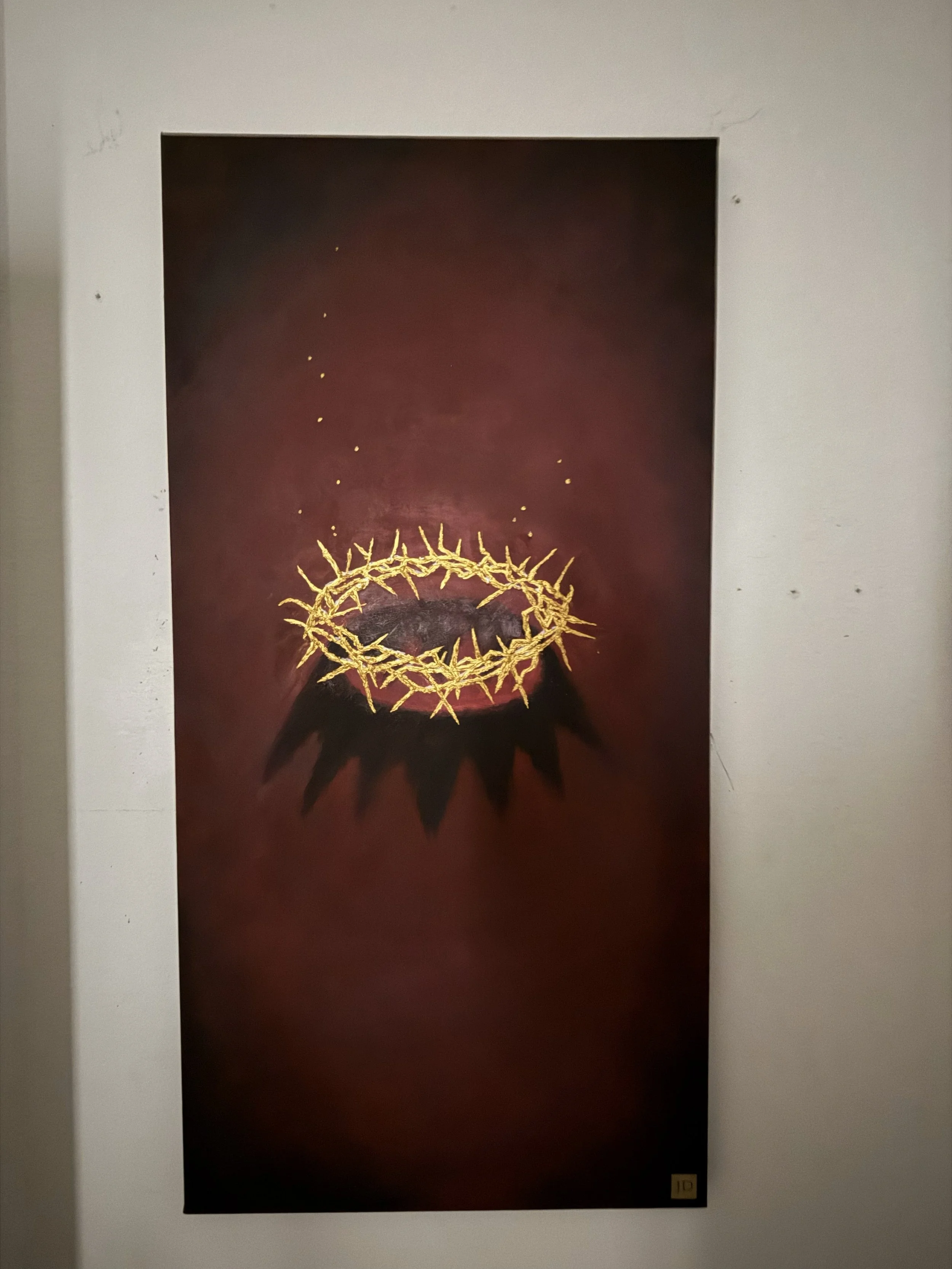
Below is a painting that illustrates two aspects of the identity of Jesus.  Fully man and fully God. In flesh that was able to be mocked, pierced, and broken for us. In spirit that is eternal and without ceasing.

He began his life on earth in a manager in Bethlehem (the Roman empire’s newest taxpayer already reporting for his first census) and it “ended” 33 years later in a shameful criminal’s death on a cross.  But, these were both temporary identities.  His true identity, as Isaiah foretold, was “wonderful counselor, almighty God, everlasting father, prince of peace” (9:6).  Peter rightly identified Him as “the Christ, the Son of the living God (Matthew 16:15).

As you look at the art, pray for God to speak to you through the image and the symbolism that is portrayed. 

Note the details of the crown of the thorns.  How real they were. The pain they could inflict.

Consider also the shadow, always present, of the royal crown.  A royal crown laid down willingness to sacrifice himself for us.

What else jumps out to you?

Pause:

Focusing on the scriptures above and this image, ponder the following questions.

·       What are all your various identities?  List out all the roles that you play in your home, family, community, church, or business environment.  What titles or descriptions have been on your business card, LinkedIn profiles, Christmas cards or correspondence, government-issued IDs, email signatures, exercise leader boards, social media headlines, or the like?

·       What was Jesus’ earthly identities?  How many of them overlap with your own?

·       What is your true identity?

·       How does that change how you think about your assignment in this time of transition?

________________________________________________________________________________________________________________________________________________________________________________________________________________________________________________________________________________________________________________________________________________________________________________________________________________________________________________________________________________________________________________________________________________________________________________________________________________________________________________________________________________________________________________________________________________________________________________________________________________________________________________________________________


Comment